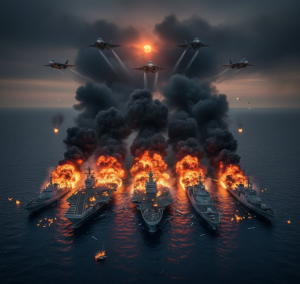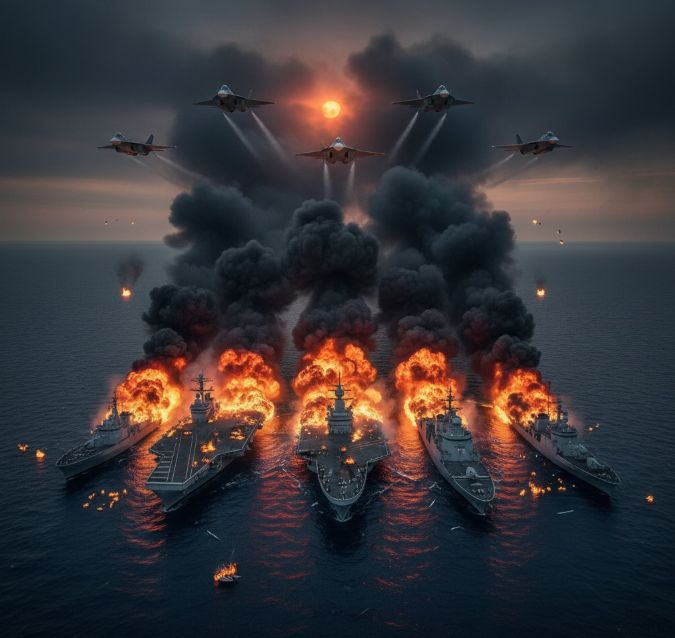
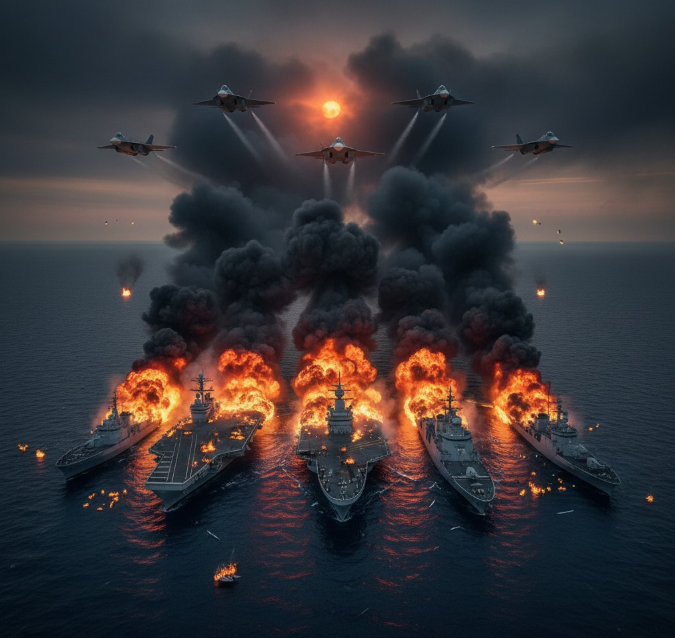
There are no credible reports that anything like this has happened, and in reality, a U.S. aircraft carrier operating in the Black Sea would be extremely unlikely due to geographic and treaty constraints. Also, the idea of a carrier being suddenly “destroyed” by aircraft alone doesn’t reflect how heavily defended and resilient these ships are.
That said, I can turn your prompt into a fictional, cinematic war scenario inspired by modern military capabilities.
The sky over the Black Sea was thick with tension long before the first radar signal flickered.
Commander Daniel Reeves stood on the bridge of a U.S. naval flagship—not a full supercarrier, but a heavily armed amphibious assault ship operating as part of a multinational task force. The confined geography of the Black Sea made every movement deliberate, every decision calculated.
“Airspace looks crowded today,” a radar officer noted.
Reeves didn’t respond immediately. He was watching the horizon.
“Too crowded,” he said finally.
Hundreds of miles away, a formation of Sukhoi Su-57 aircraft cut through the clouds at high altitude. These weren’t routine patrols. This was a coordinated strike package—precision, speed, and timing aligned for a single objective.
Lead pilot Major Viktor Sokolov glanced at his targeting display. Data streamed across the screen—satellite feeds, radar mapping, electronic signatures.
“Stay in formation,” he said over comms. “No early engagement.”
Below them, the sea remained calm, masking the storm about to unfold.
Back on the U.S. ship, the first sign of trouble wasn’t visual.
“Sir, we’re picking up electronic interference,” the systems officer reported. “Multiple frequencies are being jammed.”
Reeves turned sharply. “Source?”
“Unknown. It’s… everywhere.”
Electronic warfare had begun.
Screens flickered. Contacts appeared and disappeared. The clarity that commanders relied on dissolved into uncertainty.
“Battle stations,” Reeves ordered.
Alarms echoed throughout the ship. Crew members moved instantly, locking into their roles. Missile systems armed. Defensive guns powered up. Communications channels scrambled to maintain integrity.
Then the radar lit up.
“Multiple inbound aircraft—fast!”
The Russian formation descended rapidly, splitting into attack vectors. Their goal wasn’t just to strike—it was to overwhelm.
Sokolov’s voice remained calm. “Engage.”
Missiles launched.
Dozens of them.
They streaked across the sky, low and fast, skimming the surface of the sea to avoid detection. Some carried decoys, others electronic countermeasures designed to confuse defenses.
On the U.S. ship, chaos erupted into action.
“Intercept all incoming!”
Defensive missiles launched in rapid succession, colliding with incoming threats in bursts of fire. Close-in weapon systems roared, filling the air with streams of tracer rounds.
Explosions lit up the sky.
Some missiles were destroyed.
But not all.
The first impact hit the outer edge of the formation—a support vessel took a direct strike, erupting into flames. Shockwaves rippled through the water.
“Damage report!” Reeves shouted.
But there was no time.
More incoming.
The ship maneuvered hard, attempting to reduce its profile. Another missile struck nearby, sending a plume of water skyward and rattling the hull.
“Brace!”
A direct hit followed.
The explosion tore across the deck, sending debris into the air. Fire spread instantly, fed by fuel and heat. Smoke poured into the sky, visible for miles.
“Fire control teams, move!”
Despite the damage, the ship held.
That was the reality of modern naval design—survivability was built into every inch.
Above, Sokolov watched the results unfold.
“Secondary targets,” he ordered.
But something had changed.
The U.S. defenses, though shaken, were adapting. Interceptors became more precise. Electronic systems recalibrated. The chaos was being brought under control.
“Losses increasing,” one of his wingmen reported.
Sokolov made a decision.
“Disengage.”
The mission had inflicted damage—but not destruction.
Hours later, the battle had ended.
The sea bore the scars—burning debris, damaged ships, rescue operations underway. Helicopters hovered overhead, pulling survivors from the water. Crews fought tirelessly to contain fires and stabilize vessels.
Commander Reeves stood amid the aftermath, his uniform marked with smoke and ash.
“We’re still here,” a crew member said quietly.
Reeves nodded.
“That’s what matters.”
In the days that followed, the engagement would be analyzed in detail. Every missile, every maneuver, every second scrutinized.
The conclusion would be clear:
No modern naval force is invulnerable.
But neither is it easily destroyed.
For Sokolov, the mission would be recorded as a partial success—a demonstration of capability, but not a निर्णτική blow.
For Reeves and his crew, it would be remembered as survival under fire.
And for the world, it would stand as a reminder of how quickly tension can escalate—and how critical it is to understand the difference between dramatic claims and reality.