In the vast silence of the desert, where endless waves of sand stretch toward the horizon, even the smallest movement can be seen from miles away. Satellites circle high above the Earth, drones scan the ground from the sky, and advanced missile systems track their targets with deadly precision. In such an environment, hiding anything seems almost impossible. Yet sometimes, the greatest weapon in warfare is not power or technology—it is deception.
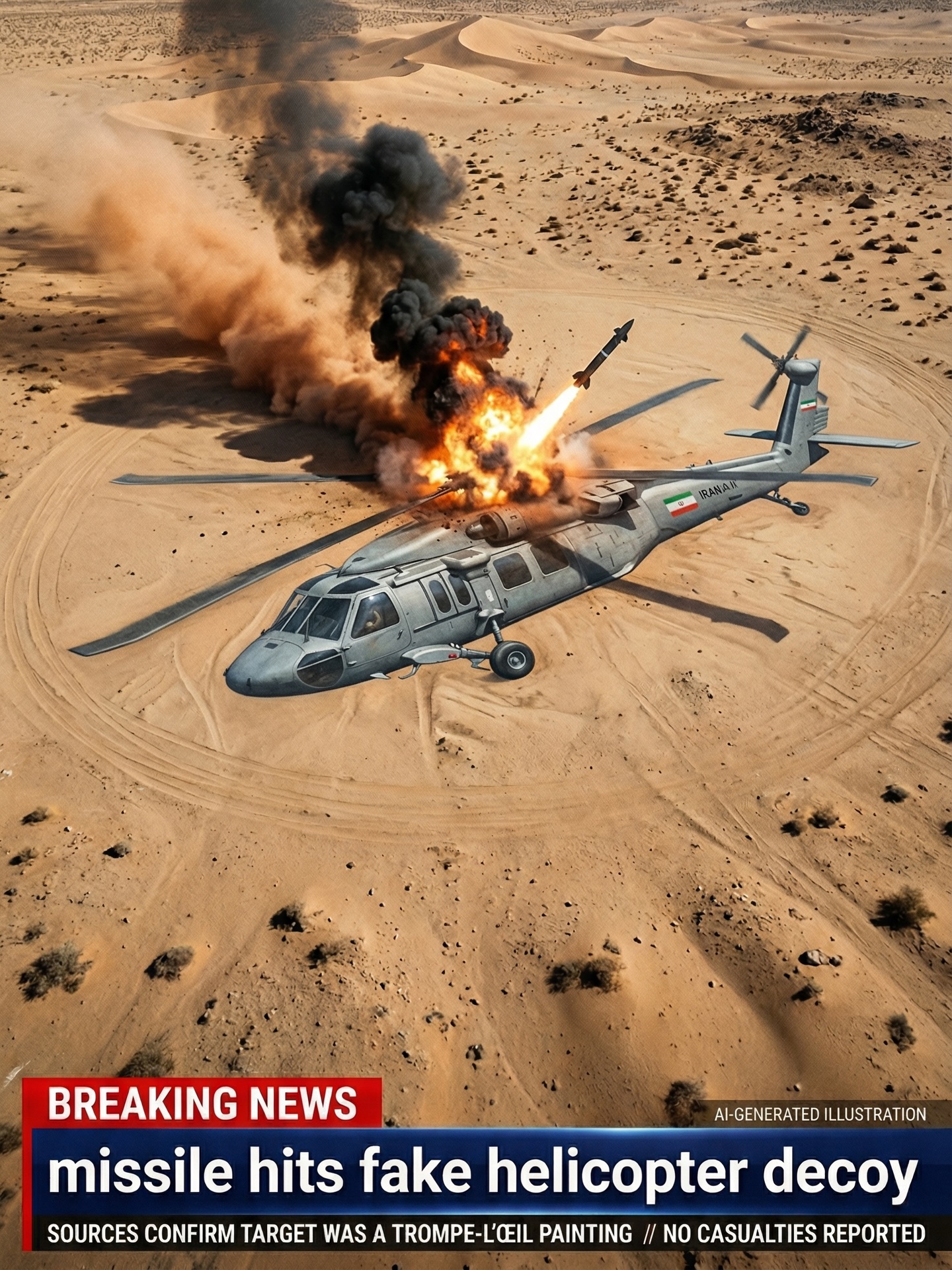
One morning, under the blazing sun of a remote desert region, surveillance systems detected what appeared to be a military helicopter resting on the sand. From above, the aircraft looked perfectly real. Its long rotor blades stretched across the ground, its body cast a shadow that matched the direction of the sunlight, and its metallic shape reflected light exactly like a real helicopter would. To any observer looking through satellite images or drone cameras, it seemed like an obvious target.
Intelligence analysts monitoring the area believed they had discovered an opportunity. A helicopter sitting alone in the open desert could represent a high-value military asset. If destroyed, it could weaken operations in the region. After verifying the coordinates and confirming the target through aerial imagery, the decision was made quickly.
A missile was launched.
Far above the desert sky, the missile cut through the air with incredible speed. Guided by advanced tracking systems, it locked onto its target and descended rapidly toward the supposed helicopter. Moments later, a massive explosion erupted in the middle of the sand.
Flames burst upward. Thick black smoke rose into the sky. The blast sent sand and debris flying across the desert floor, creating a dramatic scene that could be seen from miles away. For a brief moment, it appeared that the mission had succeeded.
But what happened next stunned analysts.
When reconnaissance drones later surveyed the blast site, they discovered something unexpected. There were no scattered helicopter parts, no twisted metal, no wreckage of a destroyed aircraft. Instead, investigators found something unusual on the ground—a large painted image on the sand.
The helicopter had never been real.
It was a decoy.
Military strategists had carefully created an enormous painting on the desert floor designed to look exactly like a real helicopter when viewed from the air. The image was crafted using a technique similar to trompe-l’œil, a form of art that tricks the eye into seeing three-dimensional objects where none actually exist.
From ground level, the image may have looked like nothing more than shapes and colors. But from hundreds or even thousands of meters above, the illusion was perfect. The painted helicopter included detailed shading, carefully drawn rotor blades, and realistic shadows that matched the angle of the sun. Even small details such as landing gear and cockpit windows were included to enhance the realism.
The result was astonishingly convincing.
To satellite sensors and aerial surveillance systems, the decoy appeared identical to a real aircraft. When analysts reviewed the images, they believed they had located a genuine helicopter positioned in the desert.
In reality, the target was nothing more than paint on sand.
By the time the missile struck, the deception had already achieved its goal.
The explosion destroyed only the painted surface and scorched the surrounding desert. No helicopter was lost, no equipment destroyed, and—most importantly—no lives were put at risk. Instead, the attackers had unknowingly wasted a highly expensive missile on a clever illusion.
Military experts later described the incident as a perfect example of strategic deception. Throughout history, armies have used decoys to mislead their enemies. During World War II, inflatable tanks and fake aircraft were used to confuse reconnaissance missions. Entire “ghost armies” were created using sound effects, fake radio transmissions, and dummy equipment.
But in the modern era, where satellites and advanced sensors dominate the battlefield, many people believed such tricks were outdated.
This event proved otherwise.
Despite the presence of cutting-edge technology, the decoy succeeded because it exploited a simple human assumption: what looks real must be real. Even the most advanced surveillance tools still rely on visual interpretation, and when an illusion is crafted carefully enough, it can deceive both machines and people.
The cost difference between the two sides of the encounter made the situation even more remarkable. A modern missile can cost hundreds of thousands, or even millions, of dollars. Creating the painted helicopter likely required only a small team of artists, some materials, and careful planning.
In other words, creativity defeated technology.
The incident also highlighted an important lesson in modern warfare: intelligence is only as reliable as the assumptions behind it. Analysts reviewing the images saw exactly what they expected to see—a helicopter in the desert. Because the image matched their expectations, they never questioned whether it might be a trick.
The defenders, on the other hand, understood how their opponents would think. By designing the decoy to look convincing from aerial perspectives, they guided the enemy toward a false conclusion.
It was a psychological victory as much as a tactical one.
News of the incident quickly spread among military analysts and defense experts around the world. Many praised the ingenuity behind the deception, calling it a reminder that strategy and creativity remain essential even in an age dominated by technology.
Others pointed out that such tactics could become increasingly common. As surveillance systems grow more powerful, so too will the methods designed to fool them. Future battlefields may involve not only physical combat but also contests of perception—where the goal is to control what the enemy believes they are seeing.
In the end, the burning crater in the desert told a remarkable story.
A missile had flown across the sky, guided by sophisticated systems and launched with absolute confidence. Yet despite its advanced technology and destructive power, it struck nothing more than an illusion.
The helicopter it destroyed had never existed.
And somewhere, far from the blast site, the strategists who designed the decoy had proven a powerful truth: in war, the smartest move is not always to fight harder—but to make the enemy fight shadows.