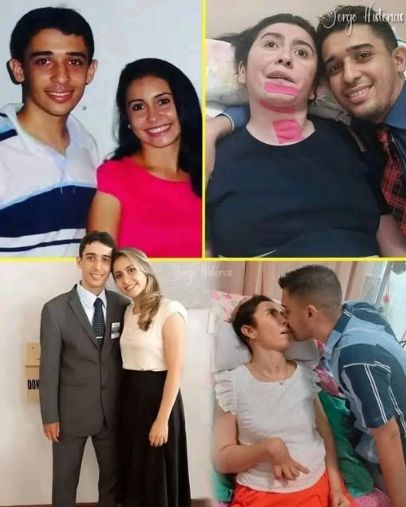
He hadn’t planned for his life to turn out this way. No one ever does. If you had asked him years ago—before the hospital rooms, before the machines, before time seemed to stand still—he would have told you about dreams filled with travel, laughter, maybe a small house with a garden out back. He would have told you about her, too, but with a smile that carried light, not the quiet ache it held now.
Her name was Elena, and she had always been the kind of person who made everything feel alive. She laughed loudly, loved deeply, and moved through the world as if every moment mattered. When she walked into a room, people noticed—not because she demanded attention, but because she gave it so freely.
He fell in love with her slowly, then all at once.
It started with long conversations that stretched into the early hours of the morning. Then came shared routines—coffee on Sundays, late-night drives, small traditions that became the foundation of something unbreakable. They built a life out of ordinary moments, and somehow, those moments felt extraordinary.
He proposed on a rainy afternoon, both of them soaked and laughing, standing in the middle of a park with no one else around. She said yes before he even finished asking.
They thought they had time.
The accident happened on a quiet Tuesday. There was no warning, no dramatic buildup—just a phone call that split his life into before and after.
By the time he reached the hospital, everything had already changed.
Machines breathed for her. Monitors flickered with numbers he didn’t understand. Doctors spoke in careful, measured tones, using words like “severe trauma” and “uncertain prognosis.” He nodded as if he understood, but the truth was, nothing made sense anymore.
Days turned into weeks. Weeks turned into months.
She didn’t wake up.
Eventually, the doctors gave it a name: a persistent vegetative state. It sounded clinical, detached—like something that belonged in a textbook, not in his life. They explained what it meant in terms of probabilities and outcomes, but all he heard was this: she might never come back.
People told him to be strong.
They told him to think about the future.
Some even told him, gently but firmly, that he needed to consider letting go.
But they didn’t know her the way he did.
They didn’t know how she used to squeeze his hand twice when she was happy, or how she hummed absentmindedly while cooking, or how she once stayed up all night just to comfort a friend who was hurting. They didn’t know the life that still existed behind her closed eyes.
So he stayed.
At first, it felt temporary—like he was holding the line until she found her way back. He read to her, played her favorite music, told her stories about their life together as if reminding her of the path home.
“I’m right here,” he would whisper. “Take your time.”
But time kept moving, even when she didn’t.
The hospital became familiar, then unbearable. The sterile walls, the constant beeping, the quiet sadness that lingered in every hallway—it all began to weigh on him. When the doctors suggested long-term care, he made a decision that surprised everyone, even himself.
He brought her home.
It wasn’t easy. Nothing about it was.
He learned things he never imagined he would need to know—how to operate medical equipment, how to prevent bedsores, how to feed someone who couldn’t swallow on their own. His days became structured around her needs, his nights interrupted by alarms and quiet checks to make sure she was still breathing.
He left his job.
Friends stopped calling as often.
The world outside his home continued, but he no longer felt part of it.
And yet, there were moments—small, fragile moments—that kept him going.
A flicker in her eyelids.
A subtle change in her breathing when he spoke.
The way her hand sometimes seemed to relax in his.
Doctors might have called it reflex. He called it hope.
People didn’t always understand his choice. Some saw it as devotion. Others saw it as denial. A few quietly wondered if he was holding on for her—or for himself.
The truth was more complicated than any of that.
Love, he realized, wasn’t just about the easy parts. It wasn’t just about shared laughter and plans for the future. It was also about showing up when there was nothing left to gain, nothing left to celebrate—just a promise, made long ago, echoing in the silence.
“In sickness and in health.”
He had meant it when he said it. He just hadn’t known what it would require.
Years passed.
His hair began to gray. Lines formed on his face where worry and exhaustion had settled in. The house grew quieter, filled only with the soft hum of machines and the sound of his voice, still speaking to her as if she could answer.
He told her everything.
About the changing seasons.
About the neighbors.
About the memories he refused to let fade.
“I remember that trip to the coast,” he said one evening, adjusting the blanket around her. “You were so cold, but you refused to leave the water. Said it made you feel alive.”
He paused, watching her face.
“You still do that, you know,” he added softly. “Make me feel alive.”
There were days when doubt crept in—quiet, persistent, impossible to ignore. Days when he wondered if he was doing the right thing, if she would have wanted this, if love sometimes meant letting go.
But then he would look at her, really look, and the doubt would fade just enough for him to keep going.
Because she wasn’t just a memory.
She was still here.
And as long as she was here, so was he.
One morning, years after the accident, something changed.
It was small—so small he almost missed it.
Her fingers moved.
Not a reflex, not the random twitch he had seen before, but something deliberate. Slow, uncertain, but unmistakable.
He froze, his heart pounding in his chest.
“Elena?” he whispered.
For a moment, nothing happened.
Then, again, her fingers shifted—curling slightly, as if trying to reach for something.
For him.
Tears filled his eyes as he took her hand, holding it gently but firmly, afraid that if he let go, the moment would disappear.
“I’m here,” he said, his voice breaking. “I’m right here.”
It wasn’t a miracle. Not yet. There was no sudden awakening, no dramatic return to the life they once knew. But it was something—something real, something undeniable.
A beginning.
And for the first time in a long time, hope didn’t feel like something he was forcing into existence.
It felt like something that had been waiting all along.
He leaned closer, resting his forehead against hers, his voice barely more than a whisper.
“Take your time,” he said again.
“I’m not going anywhere.”